
A Discovery
or, The Rabbit Hole Just Got A Little Deeper(Scientifically Speaking, of Course...)

A Discovery
or
The Rabbit Hole Just Got A Little Deeper
(Scientifically Speaking, of Course...)
Clifford E Carnicom
Sep 01 2025

Many of us are connected to our world deeply through our intuition and instinct, and that is for good reason. Our survival, in the most fundamental way, has cultivated those skills over eons of time. They are, therefore, never to be ignored.
I do not ignore them either, nor have I ever. But to bring that individual knowledge and awareness to the wider public requires a pathway, and we all share in that journey together. One of those pathways happens to be the scientific route, where it has the advantage that two people get to see the same thing at the same time, and thereby affirm their collective consciousness.
The gestalt of the modern world strongly foretells of the “transhumanist” agenda. We shall see that the concern is well grounded. It always helps to have something that we can see and work with, and that is what this paper is about.
The finding of this paper is that the synthetic biology (CDB) that has been unleashed upon this planet for close to 30 years, by the best available research of Carnicom Institute (CI), has the ability to absorb and use electromagnetic energy for its own growth and metabolism. This is indeed a, if not the, holy grail of the synthetic biology agenda. This achievement represents an entire transformation of biology.
Instantaneously , most all contemporary ideas, discussions and speculation in the uncensored environment about ‘transhumanism” become germane and relevant. You might easily call it digital, as well as synthetic. You might even begin a discussion on whether “food”, as we know it, is to be required. Quite the potpourri to be put on the table with such a finding.
The folks that prefer abstracts only might prefer to detour at this time.
________________________________________________________
________________________________________________________
A summary of some of the results will be provided in this paper to open up the the topic for future discussion. We must always be cautious of assuming any conclusions are final and forever, but we must also not obstruct infinitum to no good cause.
The background for this paper is somewhat extensive, and it will be unreadable at the appropriate level if it were all stated now. The laboratory notes of CI are a primary repository for the details; that topic will be discussed further in a separate paper. In general, this background includes, as a minimum:
1. Some recent interesting, serendipitous, and somewhat complex scientific electromagnetic research by CI over recent weeks.
2. An awareness of extensive previous electromagnetic work by CI over previous decades (e.g, search ELF), including the reporting of an ambient, assessed artificial, ELF (Extremely Low Frequency) field reported across many papers.
3. Unpublished CDB (synthetic biology) culture electromagnetic studies that took place approximately a decade ago. It will have to be seen what, if any, records of that work remain.
4. A six-part CI research paper completed in the fall of 2022 titled, “Blood Alterations”. The final segment of that series reluctantly introduced the phrase “kill switch” into the research, but I am not sure how often that paper has been read.
One would need to be somewhat aware of this previous work to fully appreciate the scope and sequence of the current work. That will be a separate effort beyond the items mentioned today. It appears that a few years of work have converged into a more comprehensive picture.
Now let us report on some recent activity that brings this paper and topic to the forefront. From hereon, more details than above will rule the roost.
________________________
We start the discovery with a case study of skin affliction as a consequence of synthetic biology (CDB), a topic extensively developed within this site. Identification is simple and repetitious with the use of microscopy alone, and examples are given in the recent paper, “Cruel and Unusual Suffering”, Aug 2025. Please refer to that paper for an additional reference point.
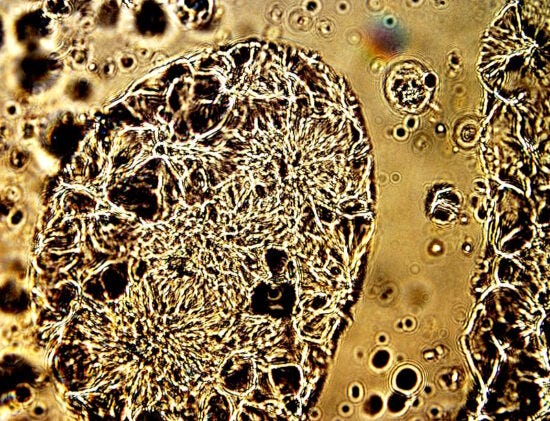
CDB (Synthetic Biology) in Afflicted Skin
Original Magnification 3200x
For those that may have missed it over the years, here is the iconic disclaimer:
“Note: I am not offering any medical advice or diagnosis with the presentation of this information. I am acting solely as an independent researcher providing the results of extended observation and analysis of unusual biological conditions that are evident. Each individual must work with their own health professional to establish any appropriate course of action and any health related comments in this paper are solely for informational purposes and they are from my own perspective.”
The existence and opportunity of this particular case study happens to be the serendipity of the discovery process.
The question arises, is there any difference in the electrical behavior of the skin of the afflicted skin vs. adjacent, normal appearing skin. If so, how might that be measured?
And thus, experimentation begins...
Note : Bear in mind that all descriptions given here are of a PASSIVE nature; NO powered signal beyond instrumental operation and requirement is being introduced within the observations described. NO DESCRIPTION, DISCUSSION OR ANALYSIS OF ANY INJECTED OR INTRODUCED SIGNAL INTO HUMAN BIOLOGY APPLIES WITHIN THIS RESEARCH PAPER. This is an entirely separate topic of discussion, and CI is clear on the record of risks with that activity.
What is found:
1. First, the 60 Hz ambient power grid field is detectable by itself in the local environment with some fairly standard equipment, including a suitable multimeter and oscilloscope. The sensitivity of instruments is, however, an important factor. A person can simply handhold the probes and that ambient field is often detectable. One can revisit journeys that I took years ago to remote locations to try and remove this ambient “interference” in sensitive electromagnetic work. ELF detection circuits were also designed and built in years past. My understanding is that the human body is acting as a “capacitive antenna” in this situation. It also informs us that even the ambient power grid has at least some form of interaction with our biology, however slight we might think that be.
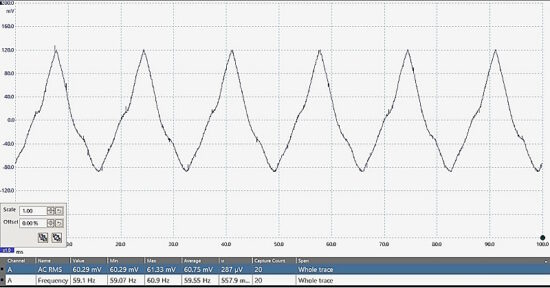
Representative Measurement of the Ambient 60 Hz Power Grid Signal
Propagated through Normal Skin in Passive Mode
2. The frequency behavior from probes upon the skin, both in normal and afflicted regions, can be studied within this ambient 60 Hz field. Results indicate that in normal skin the 60 Hz ambient field propagates without measurable difference or change of 60 Hz measurement on the human body. A variety of test locations were used, and the ambient power grid influence remained steady across healthy skin tissue
3. The frequency behavior from probes upon the skin in an afflicted region, however, was not as above. It measured higher, generally within a range of ~400 - 1200 Hz. This can, and did, spark a flint of curiosity. As Alice might say, “curiouser and curiouser”...
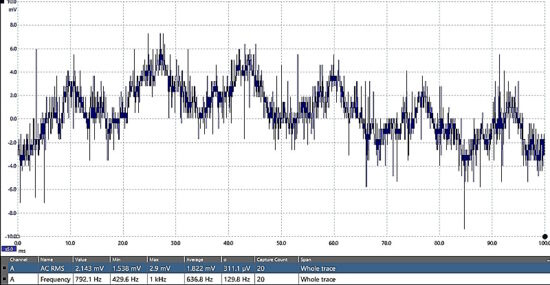
Representative Measurement of the Afflicted Skin Frequency Response
in Passive Mode
A Change in Frequency Occurs (Factor ~8 to 20)
A Voltage Drop (current flow) Occurs (Factor ~20 to 30)
Modulated Signal Results
Return to normal appearing skin, and the measurement returns to the ambient power grid field of 60 Hz. Repeat and repeat.
4. The next observation is that a voltage drop occurred in correspondence with the shift from normal skin to afflicted skin probe placement.
5. Interpretation of this observation now becomes important. A voltage drop signifies that a current flow is taking place. A variation in the waveform of the ambient 60 Hz AC signal indicates that some form of combined modulation of the two separate signals is taking place within the afflicted area.
6. A further and deeper analysis of these results portray what may be a very unique phenomenon taking place. This is the prospect that the afflicted region has its own electromagnetic signature in comparison to that of normal or healthy skin/tissue. Greater knowledge about the origin and nature of that phenomenon becomes, therefore, of high interest.
_________________________
This is a good time to set back, and realize that nature is full of clever ways to trick our rules, hypothesis, assessments and conclusions from scientific endeavor. A good question to always ask is if there is another way of approaching the already significant interpretation falling into place.
Another field of study here holds promise within the quest, and that is of electrochemistry. I have forays into that study area in years past, and the papers will record such occasions. One of the many benefits, that prompted my introduction, is that it provides a means to identify the inorganic constituents of a compound (metals and such).
Another subdivision of electrochemistry is that of “Electrical Impedance Spectroscopy (EIS)”. I have similar explorations with those means in the past as well. One of its benefits is that it can allow for the creation of an “equivalent electric circuit” to represent more complex electrical behavior. In this case, my need was for an even more basic measurement.
This measurement applies to AC circuitry (which is under examination here) and it is impedance vs frequency for a given voltage. Let’s step back for another moment and describe the value and importance of this measurement in this case.
P.S.
If you have made it this far, you are doing quite well. It likely takes even longer on my side...
It is hard to be able to measure current directly in human tissue. Current measurement requires that the instrument be “in-line” within the circuit, and that is not practical in this case. So we are left to other means, some of which have already been presented, such as frequency and voltage.
Now let’s briefly describe impedance. Many of are familiar with the concept of resistance in an electrical circuit. Every electrical circuit requires some form of opposition to current within it, and this is resistance. In layman terms, what is creating heat in a circuit can certainly be taken as resistance, including a light bulb, for example.
Without becoming too involved with the differences between AC and DC circuits, resistance applies to DC circuits and the term impedance is used to apply to AC circuits. Conceptually at the root level, resistance and impedance can be viewed in the same fashion, i.e, opposition to current flow. This opposition in AC circuitry is more complicated to express, but it is still opposition to current flow.
And so, in this case, we have impedance (opposition to current flow) and frequency (the 60 Hz power grid) active in the skin tissue questions above. If we can measure these two things, we are in the end getting a readout of current flow in the skin because of some fancy instrumentation that gets used in the process. In the end, if you have less opposition (impedance) of current in one circuit vs another, then you will have more current flowing in that first circuit.
Current, frequency, voltage and impedance variations between normal and afflicted skin from synthetic biology, in the end, can be very important and valuable for us to know and understand.
_________________________
Not exactly the Oscars, but the winner is:
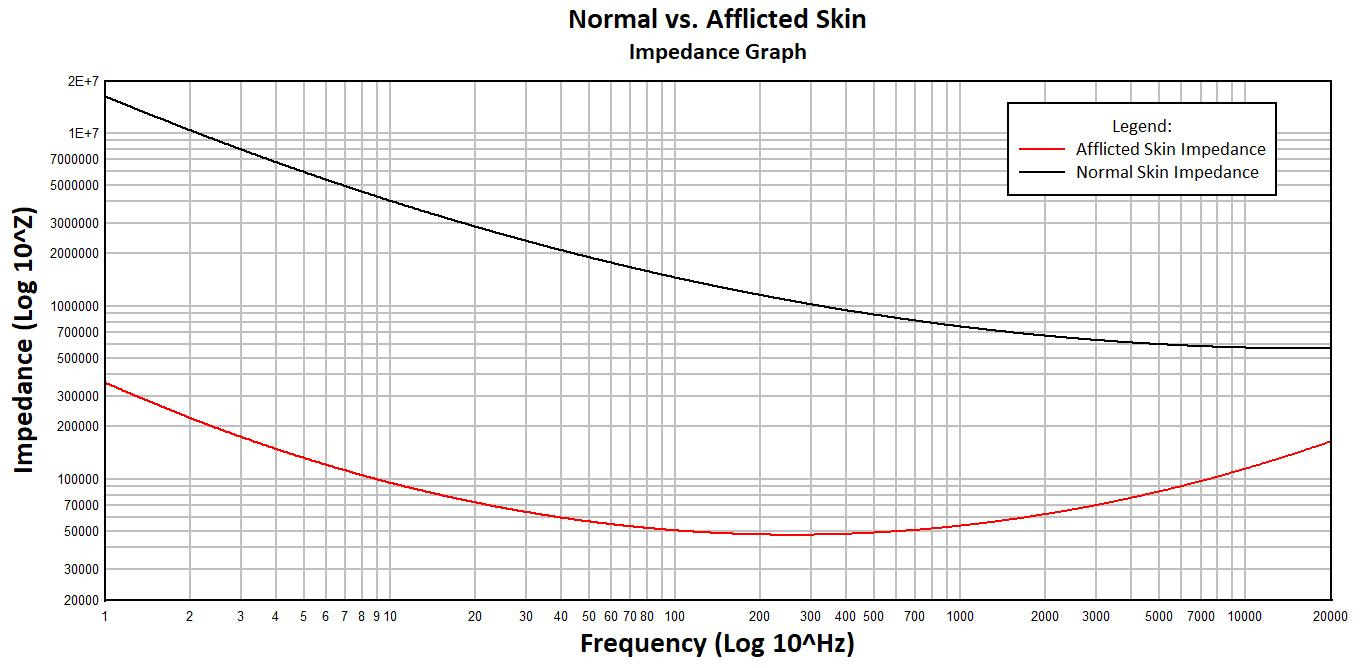
The impedance of the afflicted skin from the synthetic biology (CDB) shows itself to be less than that of the normal skin across the range of frequencies examined (1 Hz to 20,000 Hz).
What this means is that two entirely different approaches and methods have been used to examine the electrical characteristics of normal skin vs synthetic biology afflicted skin (CDB) and both say the same thing.
1. This is, in essence, that a distinct electrical field, i.e, signature, of the afflicted skin via synthetic biology exists.
2. Furthermore, I am unable to find (at this time) any historical scientific record of any bacterial species, let alone the incorporation of synthetic biology within it, that produces any similar finding, i.e, that of a unique, coherent, and relatively intense electrical field generated by harvesting electromagnetic energy from an ambient field and then using that same energy for its own growth and metabolism.
Bacterial impedance is a recognized and active field of scientific study. These studies appear to center on monitoring the growth of various species over time, but they are not known (at this time) to be involved with electromagnetic signatures of species in real time.
The consensus found on the electrical nature of bacterial species is that they are of low level intensity, not coherent in the fashion observed, and that the biophysical characteristics observed are not known to exist in the natural world. It is anticipated, at this time, that such results, could only be developed in conjunction with the motives of synthetic biology itself. This would be a portion of the Holy Grail that has been referred to.
_________________________
And now we carry the reasoning process and interpretation even a bit further.
Let’s reestablish the situation that we see:
1. The afflicted region demonstrates electrical interaction with the ambient power grid of 60 Hz.
2. When subjected to frequency fields ranging from 1 to 20,000 Hz it shows a similar response.
3. Synthetic biology existence (CDB) is at the core of and defines the physical nature of the afflicted region.
4. The electro -biophysical response is directly tied into the existence and location of this same synthetic biology (CDB).
5. The electrical responses are measured using different methods that result in the same conclusions and interpretations.
6. The synthetic biology shows the ability to transform, or modulate a 60 Hz ambient electrical field into one of a higher frequency for its own use.
7. The resonant frequency of the afflicted tissue, as determined by the minimum point of impedance, has been shifted from ~1000 Hz in healthy tissue to ~200 Hz in afflicted tissue. This signifies a shift toward the ambient 60 Hz power grid which increases the efficiency of energy capture. This indicates a sophisticated and designed engineered mechanism that has been incorporated into synthetic biology.
8. The current flow in the afflicted region is greater than that of adjacent normal tissue.
9. A modulated electromagnetic signal has the potential to transmit/receive information. This is what a radio does. This establishes a basis for bio-communication with and by the synthetic biology, both transmit and receive. Profound implications herein.
10. The phenomenon recorded here are not known to exist in the scientific historical record
11. Synthetic biology itself seems to be a prerequisite for these observations to exist.
12. These observations provide the basis for a complete transformation of biology as it is known to exist.
The existence of the global 4 Hz ELF field of previous research must be considered in conjunction with these findings that relate to universal global power grids. Although the range of AC frequency “input” fields is finite here, conceptually there is no reason to restrict these observations to a particular frequency range. The application of ambient frequency fields ranging from the hertz to the terrahertz range must be inclusively considered.
There are diagnostic prospects for the information presented here, including that of identification, mapping and monitoring the affliction non-invasively.
This combination of observations leads to the interpretation and conclusion that the synthetic biology is essentially “harvesting” or accruing energy from the ambient electrical field (ie., power grid in this example), and transforming that energy into a higher frequency state and increasing current flow within the afflicted area. This synthetic biology is using this same energy for its own survival, metabolism, productivity and reproduction. As a result of the modulated signal detected, bio-communication, both transmit and receive, is inherent in these findings. At this point, there is no known reason to restrict the range of frequencies that may enable the synthetic biology (CDB) to accomplish this. It would be wise, at this point, to consider the properties observed applicable to a wide range in frequency.
When the “background” research of CI over previous decades is included within the assessment, the viability of this conclusion is substantially strengthened even further.
_________________________
For clarity, the following caveat will be repeated:
Note : Bear in mind that all descriptions given here are of a PASSIVE nature; NO powered signal beyond instrumental operation and requirement is being introduced within the observations described. NO DESCRIPTION, DISCUSSION OR ANALYSIS OF ANY INJECTED OR INTRODUCED SIGNAL INTO HUMAN BIOLOGY APPLIES WITHIN THIS RESEARCH PAPER. This is an entirely separate topic of discussion, and CI is clear on the record of risks with that activity.
Nevertheless, potential disruptive mechanisms are most certainly a prospect with the competent study and application of the means, methods and findings discussed here.
Clifford E Carnicom
Sep 01 2025
born Clifford Bruce Stewart
Jan 19 1953
Hello Clifford
i put a wireless phone charger in the incubation chamber and had fiber growth in 5 days after inoculation in nutrient agars and Tryptic Soy Agars both modified and non modified. The modified TSA gave fast culture times but also seemed to encourage polymerization after fiber growth in incubator, then plates were put in desiccation chamber for abiotic stress observations. The whole plate of agar turned into a hard polymer disc.
This is the conductivity meter we use. It works well with saliva.
It reads 2 to 19.9mS at 0.1mS accuracy, and 20 to 199mS at 1 mS/cm accuracy with dual point calibration and temperature correction. $160
https://calright.com/product/horiba-ec22-conductivity-meter-20-199-9-ms-cm/
I have been researching Shewanella oneidensis MR-1 and cable bacteria.
Shewanella oneidensis MR-1 also is capable of producing mGO or microbial reduced graphene oxide and it is an exoelectrogen.
I have a collection of CDB ELM hexagons that grow in skin and the environment I am going to put into some experiments when the cold weather arrives here.
Thanks for posting! I had to take a break.
I only have your lead and my intuition to follow
Much respect from myself and many others
The mechanisms discussed below involve electron uptake from a solid electrode, not the conversion of ambient electromagnetic energy into usable metabolic energy.
Electroactive Bacteria
Electroactive bacteria, also known as exoelectrogens, are microorganisms capable of transferring electrons extracellularly across their cell envelope to or from electron acceptors such as electrodes, oxide minerals, or other bacteria.
These bacteria are primarily prokaryotes, including members of the domains Bacteria and Archaea, but recent discoveries have also identified electroactive capabilities in some eukaryotes, including fungi and microalgae.
They are found in diverse natural environments, including soil, water, sediment, extreme habitats like thermal vents and varnish rock, and even within the human gut.
The ability to perform extracellular electron transfer (EET) allows them to generate electrical current, a process central to applications in microbial fuel cells (MFCs) and other bioelectrochemical systems (BESs).
Exoelectrogens typically function under anaerobic or microaerobic conditions, oxidizing organic matter and transferring the resulting electrons to an anode, which then flow through an external circuit to a cathode where they react with protons and oxygen.
This process enables the conversion of organic waste into renewable bioelectricity, positioning MFCs as a green technology for wastewater treatment and energy recovery.
The first documented observation of electricity generation by a microorganism dates back to 1911, when Professor M.C. Potter observed a voltage from a yeast and bacterial suspension in a glucose medium.
Since then, key model organisms like Shewanella oneidensis MR-1 and Geobacter sulfurreducens have been identified and studied extensively.
These bacteria utilize various mechanisms for EET, including direct contact via outer membrane cytochromes (e.g., MtrC, OmcA), soluble electron shuttles like flavins and riboflavin, conductive biofilms, and electrically conductive pili (nanowires).
While Gram-negative bacteria have historically been the focus of research due to their more accessible outer membranes, recent studies have revealed that certain Gram-positive bacteria, such as Staphylococcus aureus, Enterococcus faecalis, and Streptococcus agalactiae, also exhibit significant electrogenic capabilities, challenging the previous assumption that their thick, non-conductive cell walls severely limit electron transfer.
This discovery opens new avenues for applications in implantable bio-batteries and biosensing platforms for monitoring human gastrointestinal health.
The diversity of electroactive microorganisms extends to extremophiles, including hyperthermophilic archaea, demonstrating their adaptability across a wide range of environmental conditions.
The study of these microorganisms requires an interdisciplinary approach, integrating microbial ecology, bioinformatics, and advanced sequencing techniques to understand their complex interactions within electromicrobiomes—multispecies biofilms that form on electrodes and facilitate electrical communication and syntrophic relationships.
"...(A)chievement..."?? Infesting us with this without our explicit informed consent and against our wills, against the will of all humanity?? This transhumanism is completely evil, wouldn't you agree?? It's not an advancement except for Satanism, for destroying the planet, and destroying humankind, as well as the other genus' and species!! Only the borg, both human and other animals, survive?? Resistance is NOT futile!! We can't accept any of this as a forgone conclusion!! Are you being "borged", Clifford??